

Deep cut
Wednesday, October 28, 2026
Whitesbog - the Pemberton Township cranberry village where the blueberry got tamed
I eat blueberries by the pint every July and never once asked where the big farmed ones came from. I figured some lab, somewhere far away.
I eat blueberries by the pint every July and never once asked where the big farmed ones came from. I figured some lab, somewhere far away. The answer is a sand road off Route 70 in Pemberton Township, in a little cranberry village called Whitesbog, and a woman named Elizabeth White who decided the smartest people in the Pine Barrens were the ones who picked berries for a living.
Whitesbog is quiet now. You can walk its bogs any day of the week. A little over a century ago, though, it was where a wild Pinelands shrub got turned into a crop.
How Whitesbog started as a cranberry farm
Whitesbog's story starts with cranberries. In 1857, a farmer named James A. Fenwick bought 108 acres of bog along Cranberry Run, south of the old Hanover Furnace, to grow them. The Whitesbog Preservation Trust and the village's National Register nomination both tell it that way. When Fenwick died in 1882, his son-in-law, Joseph J. White, took over.
J.J. White kept buying land. The Trust, the state and the farm's National Register nomination agree it grew to about 3,000 acres, and by the early 1900s Whitesbog was the largest cranberry farm in New Jersey. The nomination says it had earned that title by 1912.
His eldest daughter, Elizabeth Coleman White, started working on the farm in 1893, a year the Trust and the state both give. A New Jersey Historical Commission lesson, courtesy of the New Jersey State Archives, says her first real job there was "bushel man."
Why wild blueberries were a problem
The Pine Barrens were full of wild highbush blueberries. People in the Pines picked them in summer before cranberry season, and White said in a 1937 radio talk that the locals called them "swamp huckleberries." What nobody had managed was to grow them on purpose. A 2016 Assembly resolution says early farmers believed the berries couldn't be domesticated at all.
In 1911, White read a report by Frederick Coville, a botanist at the U.S. Department of Agriculture, on what blueberries need to grow. She and her father offered Whitesbog for his experiments. White's own talk, the 2016 resolution and the Arnold Arboretum all date the partnership to 1911. Coville brought the science. Whitesbog brought the land and the crew, plus the kind of sandy, acid Pinelands soil the resolution says this blueberry thrives in.
The woodsmen of Whitesbog and the little aluminum gauge
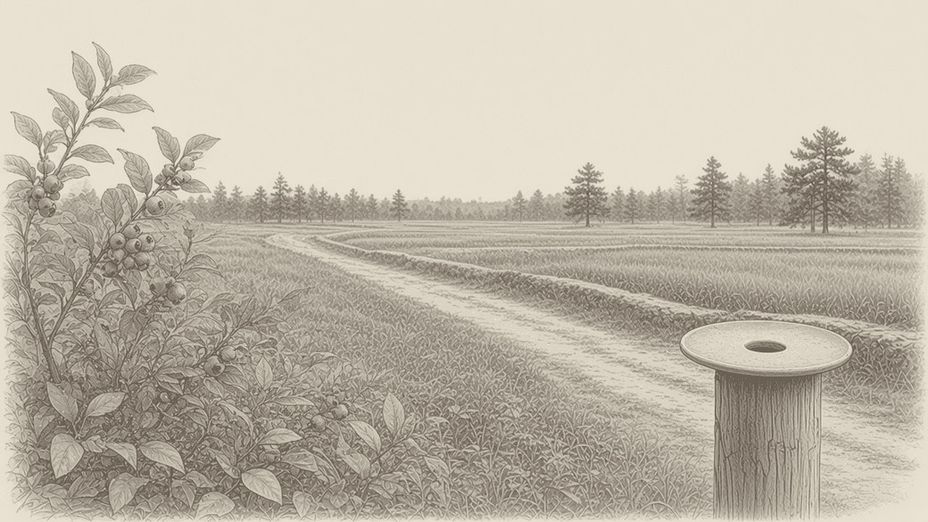
This is my favorite part, and it comes straight from White. In her 1937 talk on WOR, published as "Taming Blueberries," she said she and her father already knew the woodsmen who picked in the Pines. So they asked them to find the best wild bushes.
She handed out little aluminum plates with a hole five-eighths of an inch across. If a berry didn't fall through, the bush was worth a look. The Arnold Arboretum's history of one of those bushes and a Pine Barrens field guide that cites folklorist Mary Hufford both describe the same 5/8-inch test. White said the pickers also got small jars of formalin to keep sample berries fresh until she could inspect them, and that they were paid for their time guiding her to the bushes.
In White's words, "From 1911 to 1916 an even 100 superior wild bushes were thus located." The 2016 resolution and the Arboretum both back up the hundred.
The blueberries named after the people who found them
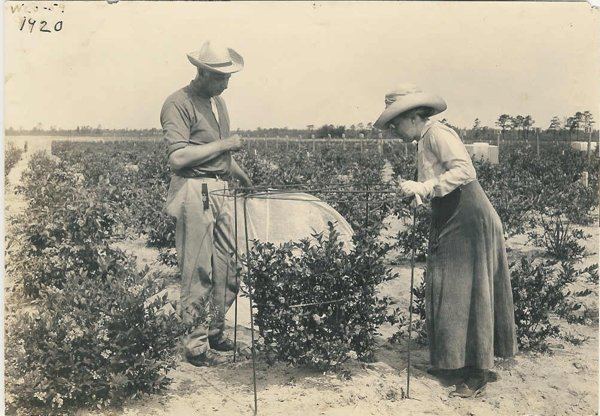
Back at Whitesbog, each wild bush was cut up and rooted into dozens or hundreds of new plants, and the new plants went into test rows. White said nearly every original bush got the name of the person who found it. That's how there came to be varieties called Adams, Harding, Grover and Dunfee. The Arboretum, which still grows a Dunfee, tells the same naming story.
Two names needed a little help. A bush found by Sam Lemmon became "Sam." And the best bush of all, White said, was found by a man named Rube Leek. She didn't think "Leek" suited it. Her explanation, word for word: "Leek savors of onions and Rube did not seem an appropriate name for so aristocratic a bush." So it became "Rubel," Rube plus the first letter of Leek. I've never heard a better reason to rename something.
Coville took cuttings from the best bushes to the USDA's greenhouses in Washington and cross-bred them, and the seedlings came back to Whitesbog to be grown out and tested.
The first Whitesbog crop
In 1916, the first cultivated blueberries were picked and sold from Whitesbog. Every source I checked agrees on that year, starting with White's own talk. The resolution calls it the world's first commercial blueberry crop.
White kept going after that. The Historical Commission lesson says she helped organize the New Jersey Blueberry Cooperative Association, and that she introduced packing the berries in cellophane, traveling to Europe to get the material. She didn't invent cellophane. She just figured out it would sell blueberries.
Whitesbog and the state fruit
The highbush blueberry is New Jersey's official state fruit. The law, P.L.2003, chapter 245, was signed in January 2004, according to the New Jersey State Library. Its opening lines credit "pioneering work by New Jerseyan Elizabeth White" and Coville "at Whitesbog, in Browns Mills." The State Library says the push for it came from fourth graders in Brick.
Whitesbog Village today
The State of New Jersey bought the village and the land around it in 1967, according to the National Register nomination and the state parks page, and it's now part of Brendan T. Byrne State Forest. The Whitesbog Preservation Trust looks after the village, which is listed on the National and State Registers of Historic Places. Elizabeth White's house, Suningive, is part of the historic district.
Visiting Whitesbog
Whitesbog is on Whites Bog Road off Route 70 in Browns Mills, Pemberton Township. The Trust lists its address as 120 W. Whites Bog Road and says the village is open daily from sunrise to sunset, and the state parks page says it's open every day. You can walk the sand roads around the bogs and look at the old village buildings from outside. Some of the village is still lived in and some of the bogs are still farmed, so stay out of closed buildings, leave the residences alone and keep off the working bogs.
Go in the next few weeks and the blueberry fields White wrote about will be turning red. In that 1937 talk she said that "autumn brings to none of our trees or bushes more brilliant reds than to blueberries." She knew those bushes better than anyone, so I'll take her word for it.
The short version
In 1911 Elizabeth White partnered with USDA botanist Frederick Coville and paid Pine Barrens woodsmen to find the biggest wild blueberries using a little aluminum gauge. They found an even 100 bushes, she named them after their finders, and in 1916 Whitesbog sold the first crop of cultivated blueberries. The village is in Pemberton Township near Browns Mills, and it's open to walk every day.